

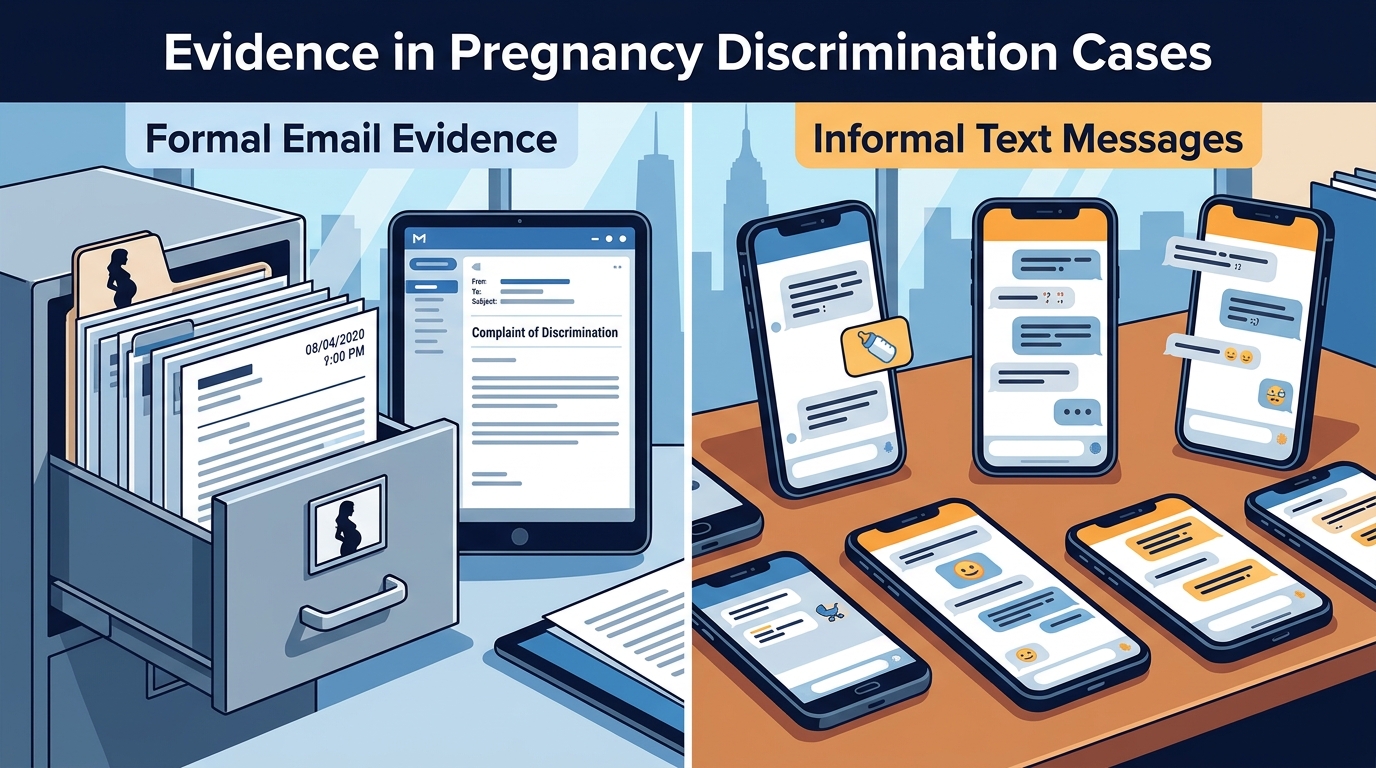
When documenting pregnancy discrimination, the format of your communication matters as much as the content. Emails generally provide a more robust, timestamped, and searchable record, making them the preferred format for formal complaints and policy violations. Text messages are often more candid and immediate but can be harder to authenticate and may lack the professional context of email. For employees in New York, understanding the distinct evidentiary weight of each channel is critical for building a strong claim with the EEOC or under the New York City Human Rights Law. For additional details, review the Just a moment.
Why Format Matters in Employment Claims
Pregnancy discrimination is a form of sex discrimination under federal law, as defined by the Pregnancy Discrimination Act (PDA). The PDA is a federal statute that prohibits employers from treating a woman unfavorably because of pregnancy, childbirth, or a medical condition connected to pregnancy or childbirth. In New York, the New York City Human Rights Law (NYCHRL) provides even broader protections, requiring a lower threshold for proving discriminatory intent. Because the legal standards vary, the quality of your evidence must be high. A vague text message may not satisfy the strict scrutiny applied in federal court, whereas a detailed email citing specific company policies can be more persuasive. The goal is to create a paper trail that clearly links the adverse action (such as termination or demotion) to your pregnancy status. For additional details, review the Just a moment.
Emails: The Formal Record
Emails are the backbone of most corporate communication. They are typically stored on company servers, which means they are less likely to be deleted by the sender if the company has a litigation hold. However, this also means the employer has access to them. When using email, you should adopt a professional tone. Avoid emotional outbursts, as these can be used to characterize you as difficult or insubordinate. Instead, use emails to document requests for reasonable accommodations, such as those required under the Pregnant Workers Fairness Act (PWFA). The PWFA is a federal law that requires employers to provide reasonable accommodations to qualified employees with pregnancy-related limitations. If you request an accommodation via email and the employer denies it, that email thread becomes a powerful piece of evidence showing a failure to comply with federal law. Emails also allow for attachments, such as doctor’s notes or performance reviews, which strengthens the narrative of your case.
Text Messages: The Candid Record
Text messages often capture the raw, unfiltered reactions of managers and coworkers. While they lack the formality of email, they can be devastating evidence if they contain explicit discriminatory remarks. For example, a text saying, "We can't keep her around now that she's pregnant," is far more incriminating than a polite email about "performance concerns." However, texts are harder to authenticate. If you are the only one with the message, the employer may claim it was edited or taken out of context. Furthermore, text messages are often sent on personal devices, which may not be subject to the same retention policies as company email. If you rely on texts, you must ensure you have a backup. Screenshotting the conversation with the date and time visible is essential. Unlike emails, which have metadata that is difficult to alter, text screenshots can be manipulated, so you must be meticulous in preserving the original data.
Comparison of Evidence Types
| Criteria | Emails | Text Messages |
|---|---|---|
| Authentication | High (Server logs, metadata) | Medium (Requires screenshots/backup) |
| Tone & Perception | Professional, formal | Candid, potentially emotional |
| Retention Risk | Low (Company servers) | High (Personal device dependency) |
| Legal Weight | Strong for policy violations | Strong for explicit bias |
| Searchability | High (Keyword search) | Low (Manual review) |
Choosing the Right Channel for Your Situation
Choose Email If...
- You are requesting a reasonable accommodation under the PWFA.
- You are filing a formal complaint with HR or management.
- You need to attach supporting documents, such as medical notes.
- You want to maintain a professional tone to avoid counter-claims of insubordination.
- You are in a role where communication is expected to be documented in writing.
Choose Texts If...
- A manager or coworker makes an off-the-record discriminatory comment.
- You are in a situation where formal channels are blocked or ignored.
- You want to capture the immediate, unfiltered reaction of a decision-maker.
- You are in a field where text is the primary mode of communication (e.g., retail, healthcare).
- You suspect that formal emails are being monitored or filtered.
Frequently Asked Questions
Can I delete text messages after I have screenshotted them?
It is generally safer to keep the original messages on your device until your case is resolved. Screenshots are secondary evidence. If the original messages are deleted, the employer may challenge the authenticity of the screenshots. Keep the original data intact, even if it is on a personal phone.
Does the employer have the right to see my personal text messages?
Generally, no. If the texts are on a personal device and not on a company-issued phone, the employer does not have a legal right to access them. However, if you use a company-issued phone, the employer may have the right to monitor communications on that device. Be cautious about what you send on company hardware.
What if my employer deletes my emails?
If an employer deletes emails after you have filed a complaint or made a request for accommodation, this may constitute spoliation of evidence. This is a serious legal violation that can lead to adverse inferences against the employer in court. Document the deletion if you become aware of it, and inform your attorney immediately.
Are voice memos better than texts?
Voice memos can be powerful, but they are harder to authenticate than texts or emails. If you record a conversation, ensure you are in a jurisdiction where one-party consent is sufficient (New York is a one-party consent state). However, written evidence is generally preferred in employment cases because it is easier to present in a legal brief.
How long should I keep this evidence?
Keep all evidence until your case is fully resolved, including any appeals. Do not delete anything, even if you settle. The settlement agreement may require you to maintain confidentiality, but it does not necessarily require you to destroy evidence. Consult with your attorney before deleting any records.
Conclusion
Preserving the right evidence is the foundation of a successful pregnancy discrimination claim. Emails provide the formal structure needed to prove policy violations, while texts capture the human element of bias. By strategically using both channels, you can build a comprehensive case that withstands legal scrutiny. If you are facing pregnancy discrimination in New York, it is essential to document everything from day one. Contact Phillips & Associates to discuss how to properly preserve your evidence and protect your rights.