

Scope of State and City Anti-Discrimination Laws
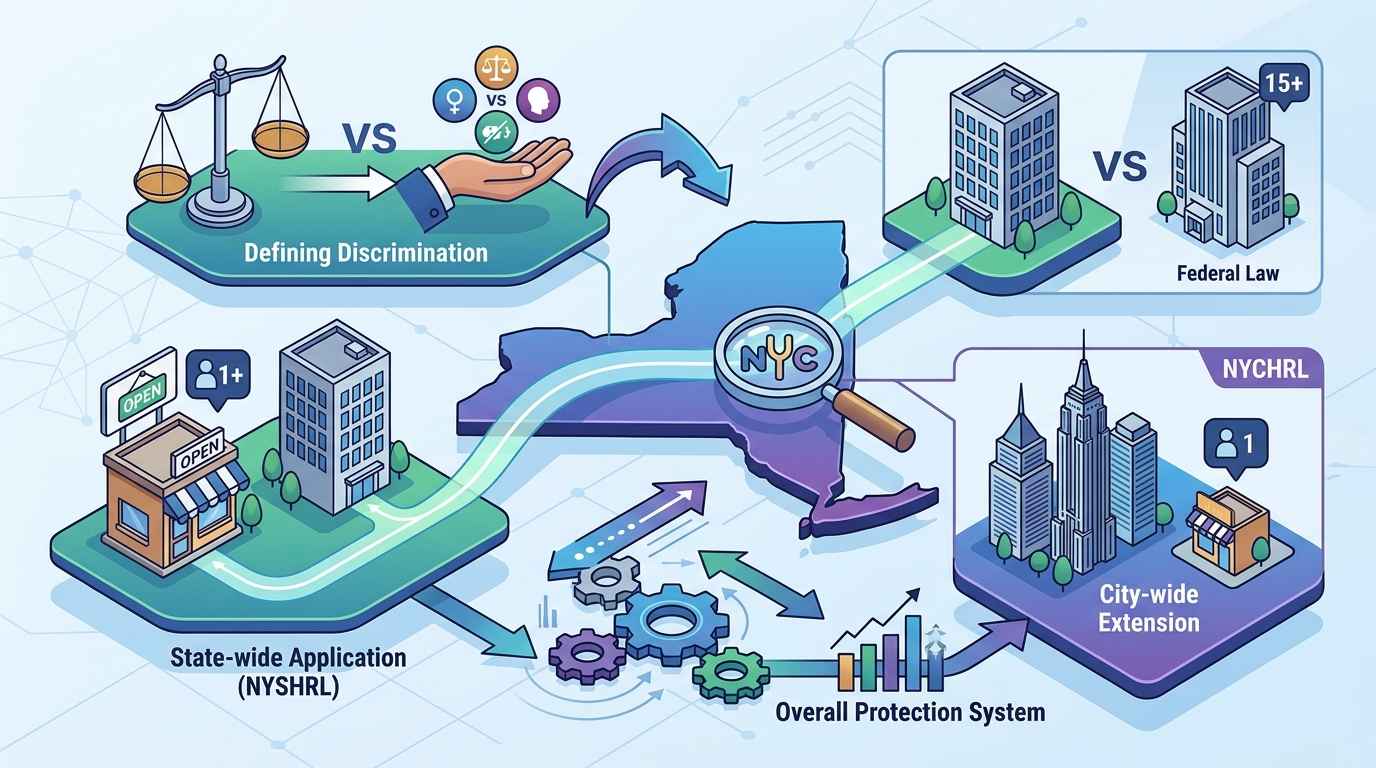
New York law defines discrimination as adverse employment actions taken because of a protected trait. The NYSHRL applies to all employers in the state, regardless of size. This is a significant difference from federal law, which typically requires a minimum number of employees. The NYCHRL extends these protections to all New York City employers, including those with just one employee. This broad scope ensures that even small business workers have legal recourse. For additional details, review the .
Protected Characteristics Under State Law
Protected Characteristics Under City Law
The NYCHRL mirrors state protections but adds specific local nuances. It explicitly protects against discrimination based on lawful off-duty conduct. It also covers status as a victim of domestic violence, sexual offenses, or stalking. The city law is interpreted very broadly by courts. This means that even subtle biases can form the basis of a valid claim. Employees in NYC benefit from this expansive legal framework. For additional details, review the Customer Experience.
Federal Protections and Their Limitations
Federal law provides a baseline of protection for workers across the United States. Title VII of the Civil Rights Act of 1964 prohibits employment discrimination based on race, color, religion, sex, or national origin. The Americans with Disabilities Act (ADA) protects qualified individuals with disabilities. The Age Discrimination in Employment Act (ADEA) protects workers aged 40 and older. While these laws are important, they have specific limitations that New York state law often overcomes. For additional details, review the Frequently Asked Questions.
Employee Thresholds in Federal Law
Title VII and the ADA generally apply only to employers with 15 or more employees. The ADEA applies to employers with 20 or more employees. If you work for a small business with fewer than 15 staff, you may not have a federal claim. However, you likely still have a strong claim under New York state and city law. This distinction is critical for workers in small firms. Phillips & Associates evaluates both federal and state avenues to maximize your options. For additional details, review the About.
Statute of Limitations Differences
Federal claims must be filed within specific timeframes. For Title VII, you must file a charge with the EEOC within 300 days in New York. State and city claims have different deadlines. The NYSHRL allows one year to file a complaint with the State Division of Human Rights. The NYCHRL allows one year to file with the City Commission. Missing these deadlines can bar your case. Understanding these timelines is essential for preserving your legal rights.
Reasonable Accommodation and Disability Rights
The Interactive Process Requirement
Medical Condition Protections
Retaliation and Whistleblower Protections
Proving a Retaliation Claim
To prove retaliation, an employee must show a causal connection between the protected activity and the adverse action. Temporal proximity is a key factor. If a negative event occurs shortly after a complaint, it suggests retaliation. However, employers may claim the action was for legitimate business reasons. The burden then shifts to the employee to show pretext. Phillips & Associates helps clients build a strong timeline of events to establish causation. This requires careful documentation and legal strategy.
Whistleblower Specifics
New York whistleblower law protects employees who disclose information they reasonably believe violates law or presents a substantial and specific danger to public health. The law prohibits employers from retaliating against these disclosures. It also protects employees who refuse to participate in illegal activities. This protection is independent of whether the underlying discrimination claim succeeds. It ensures that employees can speak up without fear of job loss. This is a critical safeguard for workplace integrity.
Key Takeaways
- The NYCHRL explicitly protects against discrimination based on gender identity, expression, and off-duty conduct.
- Federal laws like Title VII have employee minimums that may exclude small business workers from federal claims.
- Reasonable accommodation requires an interactive process between the employee and employer to resolve disability-related needs.
- Retaliation is a standalone claim that protects employees who file complaints or report illegal activities.
- Statute of limitations varies by law, with state and city claims generally allowing one year to file.
- Documentation of discriminatory acts and accommodation requests is essential for building a successful legal case.
Frequently Asked Questions
Does New York law protect employees in small businesses?
Yes. The New York State Human Rights Law and the New York City Human Rights Law apply to all employers, regardless of the number of employees. This means that workers in small businesses with fewer than 15 employees are still protected against discrimination under state and city law, even if they do not qualify for federal protection.
What is the difference between state and federal discrimination laws?
State laws in New York are generally broader than federal laws. They cover more protected characteristics, apply to smaller employers, and have longer filing deadlines. Federal laws like Title VII set a national baseline but have specific limitations, such as employee minimums and narrower definitions of disability.
How long do I have to file a discrimination complaint in New York?
You generally have one year to file a complaint with the New York State Division of Human Rights or the New York City Commission on Human Rights. For federal claims, you must file a charge with the EEOC within 300 days. It is important to act quickly to preserve your legal options.
Can I be fired for asking for a reasonable accommodation?
Yes, firing an employee for requesting a reasonable accommodation is a form of retaliation and disability discrimination. New York law protects employees who engage in protected activities, such as requesting accommodations. If you are terminated after making a request, you may have a strong legal claim.
What counts as a protected characteristic in New York?
Do I need a lawyer to file a discrimination claim?
While you can file a complaint without a lawyer, having legal representation is highly recommended. Employment discrimination cases are complex and involve strict deadlines and procedural requirements. Phillips & Associates provides expert guidance to help you navigate the process and maximize your chances of a successful outcome.
What is the interactive process for accommodations?
The interactive process is a dialogue between the employee and the employer to determine appropriate reasonable accommodations. The employee discloses their disability and needs, and the employer discusses potential solutions. This process must be conducted in good faith and documented. Failure to engage in this process can lead to a discrimination claim. Learn more: newyorkcitydiscriminationlawyer com.